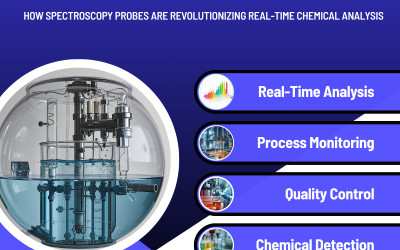
Bioreactors are the “breathing hearts” of modern bioprocessing, growing cells and micro-organisms that produce medicines, enzymes, foods and biofuels. To run them well, we must know what’s happening inside: Are cells healthy and growing as expected? Are we on track for quality and yield?
Traditional manual sampling, drawing samples for lab testing is slow, labour-intensive and risks contamination. It provides only “snapshots” rather than continuous data. Inline monitoring using fiber optic and spectroscopy techniques changes this. Using thin optical fibers and light-based measurements, we measure variables directly inside bioreactors, continuously, without removing samples.
This reduces contamination risk and workload, provides real-time insight, enables smarter control and consistent quality, and supports automation and Industry 4.0.
This blog explains bioreactors and monitoring, manual sampling pros/cons, how inline fiber optic spectroscopy works, main spectroscopic techniques, bioreactor applications, and why inline monitoring is the future standard.
1. What Is a Bioreactor, and Why Does It Need Monitoring?
A bioreactor is a controlled vessel for growing living cells or micro-organisms to make products.
Examples: mammalian cells producing antibodies, yeasts/bacteria producing enzymes, microbes producing biofuels, or cells for therapies. Inside, cells are extremely sensitive to their environment.
To keep them productive, we control temperature, pH, dissolved oxygen, nutrients (sugars, amino acids), metabolites (lactate, ammonia), cell density/viability, and product concentration.
Think of running a farm in a sealed greenhouse: you monitor and adjust light, water, nutrients and air. Bioreactors are similar, but the “plants” are microscopic and much more sensitive.
2. Manual Sampling: How We’ve Done It for Decades
How Manual Sampling Works In most facilities:
- An operator opens a sampling port and draws culture fluid into a sterile container
- The sample is labelled and carried to a laboratory
- Technicians measure glucose, lactate, pH, cell counts, product concentration using instruments
- Based on results (often 30 to 90 minutes later), teams adjust feeds, air or agitation
Pros: Familiar and proven; flexible for many tests; highly accurate with reference methods.
Cons: Time lag (reacting to past, not present); labour-intensive; contamination risk with repeated opening; limited frequency (missing fast changes); human error potential; operational stress with round-the-clock sampling. Manual sampling won’t disappear but relying on it alone increasingly mismatches modern bioprocess complexity.
3. Why Is Inline Monitoring a Step Change?
Inline monitoring measures directly in the bioreactor (or closed loop) without removing samples.
With fibre optic spectroscopy sensors, you continuously watch variables in real time, detect problems early (nutrient depletion, oxygen limitations, metabolic shifts), control processes more tightly and consistently, and reduce manual samples required.
Think of checking car oil weekly with a dipstick (manual) versus continuous dashboard sensors warning immediately if something’s wrong (inline). Inline monitoring doesn’t replace lab testing but significantly reduces reliance on it and catches issues before they become expensive deviations or batch failures.
4. Fiber Optic Technology: How Light Gets Into the Bioreactor
What Is a Fiber Optic?
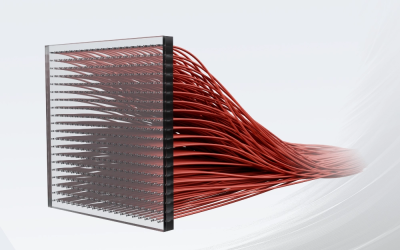
A fiber optic is a thin, flexible glass or plastic strand carrying light, similar to how electrical cables carry electricity. In bioreactors, fiber optics send light into the culture, collect light that has interacted with the culture, and bring it back to a spectrometer (an instrument that measures the light’s spectrum).
Crucially the spectrometer and electronics stay outside the bioreactor. Only a robust, sterilizable probe with fiber optics enters the controlled environment.
This makes the system easier to maintain and calibrate, compatible with clean-in-place and steam-in-place processes, and safer and more reliable in harsh or sterile environments.
Inline Probes and Flow Cells
Two main approaches:
- Inline probes: A probe with optical windows is installed directly through a port in the bioreactor wall. The fibers inside send and collect light at the probe tip.
- Bypass/flow cells: Culture fluid is circulated through a small external cell containing the optical path, then returned. This keeps the system closed while allowing convenient access for cleaning and calibration.Both approaches avoid open sampling and allow frequent or continuous measurements.
5. Spectroscopy Techniques: Different Ways of “Listening to the Light”
Once light interacts with culture, we analyse it using spectroscopy (examining how light is absorbed, scattered or emitted to determine composition and concentrations).
5.1 Near-Infrared (NIR) Spectroscopy
- Measures: Overall chemical composition (water, sugars, proteins, some metabolites)
- Strengths: Fast and robust; works well with turbid (cloudy) liquids; great for multicomponent estimation using calibration models
- Typical uses: Monitoring glucose, lactate, biomass trends; estimating product concentration (with a good model)
5.2 Mid-Infrared (IR) / FTIR Spectroscopy
- Measures: Fundamental molecular vibrations, very rich chemical information
- Strengths: Highly specific chemical information; good for identifying functional groups and certain compounds
- Challenges: More sensitive to water and optical path length; often used in flow cells rather than deep in large vessels
5.3 Raman Spectroscopy
- Measures: Vibrational information, like IR, but through inelastic scattering of light (light that changes energy after interacting with molecules)
- Strengths: Works well in water-rich systems; can directly track specific molecules (e.g., glucose, lactate, some products); often used inline through small optical windows
- Challenges: Signals are weaker than NIR; requires sensitive instruments and careful design; fluorescence from media or cells can interfere, but this can be managed with wavelength choices and data processing
5.4 UV-Visible Spectroscopy (UV-Vis)
- Measures: Absorption of ultraviolet and visible light, often linked to specific chemical groups or colour
- Strengths: Very good for certain analytes with strong absorption (e.g., nucleic acids, some proteins, certain metabolites)
- Typical uses: Monitoring cell density (optical density), some product concentrations, and specific markers
5.5 Fluorescence Spectroscopy
- Measures: Light emitted by molecules after they absorb higher-energy light
- Strengths: Very sensitive, can detect low concentrations; sensitive to cell health and metabolic state (some metabolites are naturally fluorescent)
- Uses: Monitoring cell viability and metabolic shifts; tracking fluorescently tagged products or markers
In practice, many systems combine techniques (e.g., NIR + Raman + fluorescence) and use chemometrics (advanced data analysis) to convert complex spectra into actionable numbers like “glucose = 3.5 g/L”.
6. Bioreactor Applications for Fiber Optic & Spectroscopic
6.1 Monitoring Biopharmaceutical Production (Mammalian Cells)
- Monitor: Glucose/glutamine consumption; lactate/ammonia buildup; cell density/viability; antibody formation
- Benefits: Better feeding control; early metabolic shift detection; improved consistency and yield
6.2 Microbial Fermentations (E. coli, Yeast, Fungi)
- Monitor: Substrate consumption; by-products (ethanol, acids); biomass; oxygen/CO₂
- Benefits: Tighter control in high-density processes; early limitation detection; easier optimisation.
6.3 Cell and Gene Therapies
- Monitor: Cell density/viability; nutrient/metabolite profiles
- Benefits: Higher confidence in patient-specific batches; supports real-time release testing
6.4 Industrial Bioproducts (Enzymes, Biofuels, Bioplastics)
- Monitor: Substrate/product profiles; bioreactor health for long runs
- Benefits: Increased productivity; reduced waste; more reliable operation
7. Advantages of Inline Monitoring Over Manual Sampling
7.1 Real-Time Insight:
- Continuous measurements (seconds to minutes) vs. hours between manual samples.
- Detect deviations early: nutrient depletion, oxygen problems, contamination indicators, metabolic shifts.
7.2 Reduced Contamination Risk
- No repeated opening of sampling ports.
- Closed, sterilizable probes integrated into systems.
- Important for high-value products (biologics, ATMPs).
7.3 Less Manual Work and Fewer Errors
- Fewer routine samples to draw, label, transport, and analyse.
- Automated data capture reduces errors.
- Lab resources focus on complex analyses.
7.4 Better Process Control
- Enables advanced control (feedback/feedforward based on real-time data).
- More consistent quality and yields.
- Easier troubleshooting with continuous history.
7.5 Digitalisation and Data-Rich Operations
- Inline spectroscopy integrates naturally with PAT (Process Analytical Technology) and Industry 4.0 initiatives.
- Supports building digital twins and advanced analytics models.
- More historical data for process understanding, tech transfer, and continuous improvement.
8. Pros and Cons: A Balanced View Inline Fiber Optic & Spectroscopy
Inline Fiber Optic & Spectroscopy – Pros
- Real-time, non-destructive monitoring
- Reduced sample handling and contamination risk
- Supports automation and sophisticated control
- Long-term cost savings through fewer failed batches and improved yields
Inline Fiber Optic & Spectroscopy – Cons / Considerations
- Upfront investment in hardware and integration
- Requires calibration and chemometric models (especially NIR and Raman)
- Needs some specialist expertise at setup and for ongoing model maintenance
- Does not completely replace detailed off-line assays (e.g., purity, detailed product quality attributes)
Still, when viewed over the lifetime of a product or facility, inline monitoring often pays for itself through higher robustness, lower risk, and better utilisation of capacity.
9. Summary and Conclusion
Bioreactors are central to modern bioprocessing but are complex, living systems requiring continuous understanding, not occasional snapshots.
Manual sampling and lab testing, while familiar and accurate, is slow, labour-intensive and inherently limited. Inline fiber optic and spectrometry techniques let us see what’s happening inside bioreactors in real time without removing anything.
Key takeaways:
- Fibre optics deliver and collect light from bioreactors while keeping equipment outside
- Spectroscopic techniques (NIR, IR, Raman, UV-Vis, fluorescence) convert light changes into information about nutrients, metabolites, cells and product
- Inline monitoring improves control, reduces contamination risk, saves labour and supports digital transformation
- Already used in biopharma, microbial fermentation, industrial bioproducts and advanced therapies, with accelerating adoption. Technically, inline monitoring with fiber optics and spectroscopy is mature. Operationally, it reduces risk, increases consistency and better utilises resources.
- For organisations planning future bioprocessing capabilities, the question shifts from “Should we use inline monitoring?” to “How quickly can we integrate it?”